
Despite criticism of a lack of transparency and communication from the Modi-led government, BJP leaders point to "good beginnings" on several fronts to defend its performance. Sheela Bhatt/Rediff.com reports.

"They call themselves the champions of speech and expression. But deny the same for the people of Kerala."
Government's reforms are too half-hearted. But Rahul Gandhi's Congress is too amateurish and inept to hold it to account.

Who are the NGOs in India with maximum funding in India? Which are the countries funding them? How many NGOs are registered under the law? Vicky Nanjappa finds out.

However, the certified copy of the said order was issued by the court only on May 1, 2015.
A clean sweep for the BJP and the emergence of the AAP do not look good for the Congress, which now faces a serious leadership crisis, says Bharat Bhushan
Bihar Chief Minister Nitish Kumar has shown it is possible to form an electoral base with pro-women policies that matter, so why don't other political parties replicate it, asks Devanik Saha.
One of the most pronounced features of people who shrilly demand change is that unless it comes in precisely the way they want it, they either say there has been no change, or that it is the wrong change. The Modi government, which is being accused of both things, provides an excellent and latest example of this.

'Modi is a master of convergence. By his ability to converge and add new features to a non-star idea, he is able to sell it. Like how he has turned Kutch into a tourist destination by selling the salt desert of the Rann as a flat snow desert of the night and roping in Amitabh Bachchan to sell it. In one stroke this has ensured economic returns to the people and on the other hand it has taken care of the national security angle in the sense that the border population in the Rann, which is almost entirely Muslim, is feeling better as now they are much more connected with the mainstream.' Ahead of the launch of his book on the much-debated Modi model of governance, journalist Uday Mahurkar speaks to Rediff.com's Sheela Bhatt.

The court has asked Sadhvi Pragya Thakur to pay a surety of Rs 5 lakh and surrender her passport to the National Investigation Agency.

'Slightly more than 50 per cent of all Keralites are Hindus. If we can unite as many as we can, we can create a huge difference in the political scene in Kerala.'

Bajirao, an unorthodox leader, faced much opposition during his lifetime from the Brahmins of Pune. In the last hundred years or so, he has been ignored due to caste politics in Maharashtra where he has become a 'non person' for having been born a Brahmin, says Colonel Anil A Athale (retd).

'The BJP used to be a party of decent, Hindu, middle-class people. Today, it is a party of goons. At the ground level, goons beat you up and at the senior level, the intellectuals justify the beating up.' 'On May 13, one boy sent me an SMS at 2.35 am: "Mayank sir, only five seats, what will happen?" There will be a lot of these idealist kids who want that quick transformation that may not happen. We will have to mentor them. We will have to explain to them that nations cannot be changed like that.' Aam Aadmi Party leader Mayank Gandhi, on the lessons the party has learnt from Election 2014.

'We eat first, they later; we sit on chairs and they on the floor; we call them by their names and they address us by titles,' writes Tripti Lahiri, author of Maid in India.

In a shocking first in Maharashtra's history, a mob attacked a police station last week, assaulted two policemen, dragged one of them out, paraded him with a saffrom flag and made him chant, 'Jai Bhavani, Jai Shivaji.'

Permissive communalism, as represented by the Sachar Committee report, cannot become the basis to counter the threat of majoritarianism, says D L Sheth.

'One hopes the younger generation sees Savarkar him for what he was and does not view him through a distorted prism.' 'This is the least one could do for someone who devoted his whole life to Indian freedom struggle, elimination of caste, succour to Dalits, and instilling of strategic culture in India,' says Lieutenant General Ashok Joshi (retd) and Colonel Anil A Athale (retd).

'What I want is not for the elected to tell me what they did in the 1990s or for the past 5 years,' says A Bihari Abroad. 'I would rather know what they plan to do in the next 6 months and give the people a report on the progress of these initiatives. Perhaps, a presentation on their performance and their future plans, to the electoral public, who they represent and are actually answerable to.'

The second part of BJP president Amit Shah's interview to Sheela Bhatt/Rediff.com, to mark the completion of one year of the Narendra Modi government.

A brainchild of Vishva Hindu Parishad leader Pravin Togadia, many find its agenda divisive
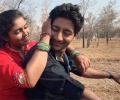
Jyoti Punwani examines the relevance of the Sairat, the hit Marathi film everyone is talking about, in today's times.
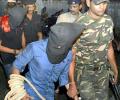
'Counter terrorism does not appear to be good guys fighting the bad ones; it is about people being picked up, detained and charged with crimes they did not commit.'
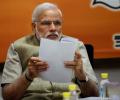
In the final part of his interview with Sheela Bhatt/Rediff.com, journalist Rajdeep Sardesai says the Congress lost the election in 2011, the year of Anna Hazare.
'After shots were fired from the front, I ducked and shifted my position instinctively.' 'I had heard from other drivers that when stones are pelted at a bus the first target is the driver.'

'The forces of good are on the run.' 'But dark times also challenge people to fight.' 'I believe Indians will rise against these dark times.'

Two whole weeks after he landed on his feet in unfamiliar territory, Patrick Ward records what it is to be a parachute journalist in the chaos called India

One hopes the higher courts take the extraordinary steps needed to secure justice for the victims. The Gujarat carnage demands nothing less because of its unique nature and sponsorship by the State, argues Praful Bidwai.

'The Ishrat encounter was neither genuine, nor fake. I believe it was a 'controlled killing,' says Shekhar Gupta.

'India has always been a land of acceptance of diversity. But if the evangelical activities continue unabated, there is no doubt this will cause a backlash.' 'One exclusive ideology begets another. The hit list will spread. The more strident the evangelists, the more strident the voices for Ghar Wapsi will grow.'
Most of the opposition parties blamed Rashtriya Swayamsevak Sangh-affiliates for the cow vigilantism.
'Arvind's face fell... He started to say something, but couldn't continue. He broke down and as the tears fell unheeded, he crumpled to the floor.'

With facts and figures, the CAG report has highlighted how Gujarat was far from a role model for states across India, and that the progress made in this province in western India in improving agriculture, education, healthcare and empowerment of women and children, was not exactly creditable, says Paranjoy Guha Thakurta.
'If there is one message coming out of Delhi, it is that the country is ready for inclusive, bipartisan politics, not based on caste, community and religion, but based on issues of a modern India.'

In Delhi, the poor are pitted against the middle class, with the former led by Arvind Kejriwal and the latter by Prime Minister Narendra Modi.

Sunday's results may be a bitter pill that the Congress has to swallow -- that its future cannot be hitched to Rahul unless he can resonate with the people, feels Saroj Nagi.

Bhendi Bazaar faces a fairytale future as the Dawoodi Bohras initiate a Rs 3,000-crore project to change it from a squalid marketplace to a swanky neighbourhood, says Ranjita Ganesan

'After the 2002 riots when the media and other political parties started blaming Modiji, thousands of people like us -- now, it must be crores of us -- started becoming staunch supporters of Modiji. The more you blamed him the more of our support he gained.' Pramod Singh of Bilaspur in Chhattisgarh is one of Narendra Modi's biggest fans and a member of Modi's India272 Web initiative, spreading the leader's message on social media and the Internet.
 © 2026 Rediff.com - Advertise with us - Disclaimer - Privacy Policy - Sitemap - Feedback - About us - Terms of use - Grievances